
While the Prime Minister did not spell out the details of the three instances, his remarks are being widely interpreted as a reference to the 2016 surgical strikes following the Uri terror attack, the 2019 Balakot air strikes after the Pulwama bombing, and the recent cross-border strikes as part of 'Operation Sindoor'.
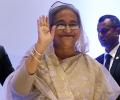
A court in Bangladesh has issued fresh arrest warrants against former Prime Minister Sheikh Hasina, her son Sajeeb Wajed, and 16 others in two cases related to alleged irregularities in allocating residential plots on the outskirts of the capital. The warrants were issued based on chargesheets filed by the Anti Corruption Commission (ACC), which alleges that Hasina and her family members illegally acquired plots in Purbachal New Town by abusing state power. The court has ordered police to submit a report by April 29 on the progress of executing the warrants. This is the latest in a series of legal actions against Hasina and her family members since her Awami League regime was toppled last year in a student-led mass uprising.
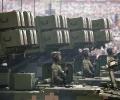
In its annual report to Congress on Tuesday on 'Military and Security Developments Involving the People's Republic of China 2025', the US Department of War said the People's Liberation Army (PLA) is actively considering and planning for additional military facilities.

Salauddin Quader Chowdhury, a key leader of the Bangladesh Nationalist Party (BNP) and considered close to former Prime Minister Khaleda Zia is accused of war crimes during the nine-month struggle against Pakistan which left three million dead.

He was convicted of running a militia torture cell, Al Badr, which carried out killings of several people.
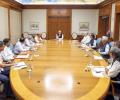
Terrorism and insurgency in J&K had subsided when India demolished East Pakistan -- for the simple reason that Pakistan understands power. We need to follow Chanakya's dictum of Saam, Daam, Dand, Bhed for strategising against Pakistan, asserts Lieutenant General Prakash Katoch (Retd). The ground truth is that unless we are prepared to acknowledge our shortcomings, including massive intelligence failures, punish those responsible and take corrective actions, we will continue in the same vein, asserts Lieutenant General Prakash Katoch (Retd).

"He was instrumental in the creation of the 'Joint Command' of Bangladesh and Indian Forces for the final assault which led to victory," read the citation conferred on Jagjivan Ram, who was India's defence minister during the 1971 war.
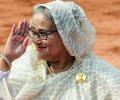
Bangladesh's interim government on Sunday said it will seek Interpol's assistance in repatriating deposed prime minister Sheikh Hasina from India, and other 'fugitives', to face trial for alleged crimes against humanity.
Records stretching back to 1947 suggest a consistent strategy by Pakistan's military and intelligence apparatus, the Inter Services Intelligence (ISI), of using terrorism as a state policy against India.
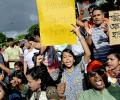
Hindu community leaders in Bangladesh are advocating the formation of a dedicated political party, reflecting a call for political representation to protect their rights and ensure their safety. Hindu leaders from the Bangladesh Hindu Buddhist Christian Unity Council (BHBCOP) and other groups are now discussing the possibility of establishing a separate political party or demanding reserved parliamentary seats.

In a culture where children take up the profession of their father, her becoming a politician was seen as natural and acceptable.
Bangladesh police have filed a case against deposed prime minister Sheikh Hasina and 72 others on charges of hatching a conspiracy to overthrow the interim government led by Muhammad Yunus by waging a civil war, officials and media reports said on Saturday.
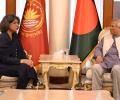
Bangladesh has demanded a public apology and compensation from Pakistan for the 1971 atrocities, raising "historically unresolved issues" during the first foreign secretary-level talks between the two countries in 15 years. Dhaka also asked Islamabad to pay USD 4.3 billion as its share from the combined assets at the time of East Pakistan's split from West Pakistan in 1971 to form an independent Bangladesh.
Some leaders of the banned Jamaat-ud-Dawa (JuD) of Mumbai terror attack mastermind Hafiz Saeed have claimed that their outfit played a role in last year's mass anti-government protests in Bangladesh that led to the ouster of prime minister Sheikh Hasina.
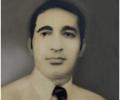
Squadron Leader Kanwal Deep Mehra's daredevilry during the 1971 War brought down a Pakistani F-86 Sabre. But he had to bail out of his plane, was badly injured. Then a fierce band of armed guerillas evacuated him to safety at great risk to their lives.
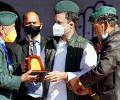
Referring to his grandmother and the former PM, he said she took '32 bullets for the country' but her name was not even mentioned at a government event in New Delhi on the anniversary of the victory over Pakistan.

Bangladesh on Friday deployed paramilitary border guards to beef up security after a top Islamist opposition leader was sentenced to death, sparking nationwide riots that killed at least 42 people.
Bangladesh police on Sunday arrested Jamaat-e-Islami leader and media doyen Mir Kashem Ali for his suspected role in perpetrating crimes against humanity during the country's 1971 liberation war.
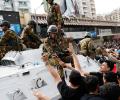
"I'm taking all responsibility (of the country). Please cooperate," he said in a televised address amid reports that Hasina has left the country.
India has to fill in all the critical gaps in missiles, ammunition, sensors and stockpile in the fastest possible manner, focusing on the critical instruments that worked this time, asserts Shekhar Gupta.

The 2025 US National Security Strategy marks a major pullback, with America turning backward and effectively allowing China greater dominance in Asia. while long-time partners like India are left to face an increasingly unstable global order largely on their own, observes Rajeev Srinivasan.
Rinki Roy Bhattacharya, journalist and writer, speaks of her experiences on being honoured by Bangladesh for helping during the 1971 liberation war.
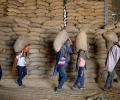
Domestic exporters on Monday expressed concerns over the crisis in Bangladesh and said the developments in the neighbouring country would have implications on bilateral trade. However, exporters expect that the situation may normalise soon. According to exporters, they are already facing disruptions in exports to Bangladesh due to a shortage of foreign exchange in that country.
Bangladesh on Monday conferred its second highest award on President Pranab Mukherjee for his valuable contribution to the country's liberation war in 1971.
When the country has been at war, the Opposition has buried its differences with the government, points out Aditi Phadnis.

Nobel laureate economist Abhijit Banerjee has said the current situation in Bangladesh is unlikely to trigger a fresh round of exodus of minority Hindus into India. He believes that migration is primarily driven by social networks and economic opportunities rather than persecution. Banerjee, known for his work in poverty alleviation, further emphasized that India's overt preference for Hindu migrants from Bangladesh in the past has been a significant factor in their migration, rather than attacks on the community.

Modi, who was wearing a 'Mujib Jacket' as tribute to Bangladesh's Father of the Nation, said that Bangabandhu's leadership and bravery had ensured that no power could enslave Bangladesh.
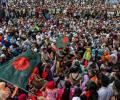
Government employees in Bangladesh locked down the main gate of the Bangladesh Secretariat in Dhaka, protesting a new service law that allows for easier dismissal of officials for misconduct. The protest, which lasted for about half an hour, disrupted government operations. The employees also threatened to continue their protests until the ordinance was scrapped. Meanwhile, the protest by employees of the Dhaka South City Corporation, demanding the installation of BNP leader Ishraque Hossain as its mayor, has brought administrative services to a halt. These protests, coupled with concerns raised by the business community and the military, highlight a growing sense of unease in Bangladesh over the policies of the interim government.
The "characterisation of bilateral relations by the Indian PM as 'nuisance' is unfortunate," Pakistan Foreign Office spokesperson Qazi Khalillulah said.

Nizami now faces execution unless his case is reviewed by the court or he is granted clemency by the President.

Wing Commander Pratap Marathe's story is one of dedication, bravery, and humour, a shining example of the spirit of the Indian Air Force. Air Commodore Nitin Sathe (retd) salutes Wing Commander Marathe who passed into the ages last week.

Our visa operations in Bangladesh constitute the largest visa operations India conducts worldwide. This has taken a hit after Sheikh Hasina's government was overthrown and India reduced its diplomatic presence in Bangladesh, notes Aakar Patel.
Bangladesh's fundamentalist Jamaat-e-Islami chief Motiur Rahman Nizami was on Wednesday sentenced to death by a special tribunal for his role in the killing of thousands of people during the nation's independence war against Pakistan in 1971.
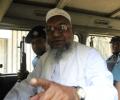
Abdul Quader Mollah, a senior leader of the fundamentalist Jamaat-e-Islami party, was executed on Thursday for genocide during Bangladesh's 1971 liberation war, hours after the Supreme Court rejected his review petition.

The Awami League leaders were charged with committing crimes against humanity over the deaths of hundreds of people during last year's anti-government protests by a student platform. The protests resulted in the ouster of Hasina's 16-year-long regime on August 5.

In response to US criticism of India's oil imports from Russia, the Indian Army shared a 1971 news clip highlighting the US's role in arming Pakistan.

73-year-old leader of the Bangladesh's largest Islamist party had refused to seek presidential clemency.
The four-member Appellate Division bench headed by Chief Justice Surendra Kumar Sinha pronounced the single-word judgement at the tense courtroom.
Bangladesh government on Monday pressed war crime charges against fundamentalist Jamaat-e-Islami (JI) leader Ghulam Azam at the International Crimes Tribunal, calling him a "key collaborator" of the then Pakistani regime during the 1971 Liberation War.

There has never been a moment in India's history when it has been so adrift in the world, so confused about what it stands for and against and so humiliated, asserts Aakar Patel.
